

THE STUDIO

Every creative work begins with a lengthy field study. After hundreds of hours spent sketching in zoos, stud farms, museums, and circuses, Michel BASSOMPIERRE has memorized the volumes, plans, muscles, characteristics, and spirit of each subject.
These sketches will be transformed into models. Clay lends itself particularly well to this work of research and analysis of forms. These small subjects will then be enlarged to create bronze and marble sculptures.
Every creative work begins with a lengthy field study. After hundreds of hours spent sketching in zoos, stud farms, museums, and circuses, Michel BASSOMPIERRE has memorized the volumes, plans, muscles, characteristics, and spirit of each subject.
These sketches will be transformed into models. Clay lends itself particularly well to this work of research and analysis of forms. These small subjects will then be enlarged to create bronze and marble sculptures.


3. MOLDING
Before it dries, the sculpture is molded to make a plaster copy.
After several weeks of drying, the sculpture is fired for several hours at a temperature of 850°C. This gives it its brick color and makes it more resistant.
4. PLASTER
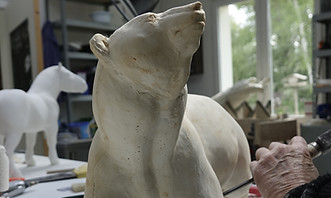
When it comes out of the mold, the plaster cast has many imperfections. A long process of sanding or adding material is then necessary. Unlike clay, plaster allows for a very fine finish.
After dozens of hours of work, the desired result is finally achieved: beautiful curves where shadow never collides with light.
The final step is to cover the plaster with a layer of gray primer, which hardens its surface and ensures that the lines are perfect. The plaster is then ready to be sent to the foundry...


TOOLS
The tools used for modeling and plastering have remained virtually unchanged since ancient times.
Since studying at the Beaux-Arts more than 50 years ago, Michel BASSOMPIERRE has continued to use the same small knife when sculpting clay.